


Build vs. Buy in Southwest Florida: What Homeowners Need to Know in 2026
If you are considering a move to Southwest Florida—or already live here and want a different home—you may be asking one of today’s most important real estate questions:
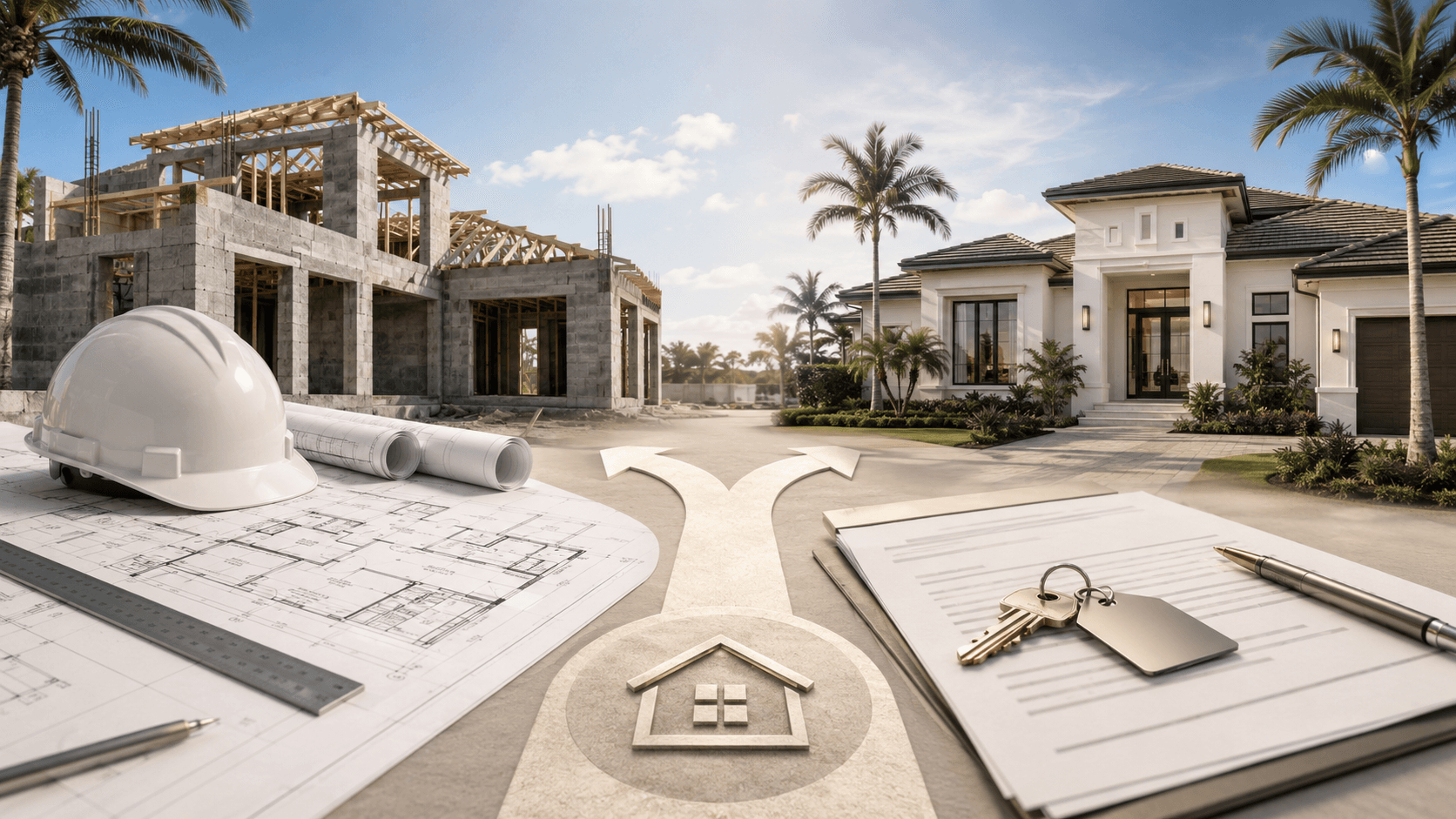
Is it better to build a new home or purchase an existing one?
The honest answer is that neither option is automatically better for everyone.
In some situations, purchasing an existing home can provide a lower initial price and a faster move-in. In others, building a new home can deliver considerably greater long-term value, fewer hidden risks and a home designed around the way you actually live.
The right decision depends on much more than the advertised price of a home or the estimated cost per square foot to build. Buyers should consider the property, location, construction quality, insurance implications, remodeling requirements, future maintenance and total cost of ownership.
Here is what homeowners should understand before deciding whether to build or buy in Southwest Florida in 2026.
Understanding the Current Southwest Florida Housing Market
The Southwest Florida real estate market has changed substantially from the conditions experienced during and immediately after the pandemic.
Buyers now have more negotiating power than they did during the peak years, and some existing homes can be purchased below what it would cost to acquire land and construct a comparable new home. Higher interest rates, construction costs and insurance expenses have also caused some investors and production builders to reduce new construction activity.
However, that does not necessarily mean that buying an existing home is the better investment.
Available resale inventory includes homes of different ages, construction standards and conditions. A home that appears less expensive at closing may require substantial improvements after the purchase. Roofing, windows, plumbing, electrical systems, air conditioning, flood considerations, storm protection and insurance eligibility can significantly affect the true cost of ownership.
At the same time, the reduction in new construction activity may create opportunities for serious custom-home clients. With fewer speculative projects competing for labor and materials, qualified homeowners may benefit from improved trade availability, more focused project management and a more deliberate construction process.
The market is no longer defined by simply building as quickly as possible. It is a market that rewards careful planning, disciplined design and informed property selection.
When Buying an Existing Home May Make Sense
Purchasing an existing home may be the right decision when speed, immediate availability and initial price are the buyer’s main priorities.
A resale home may make sense if:
- You need to move within the next few months.
- You find a home in the exact neighborhood or waterfront location you want.
- The layout already meets most of your needs.
- The property has been properly maintained and updated.
- The home’s major systems have substantial remaining life.
- The required improvements are primarily cosmetic.
- The purchase price leaves sufficient room in your budget for repairs and renovations.
An existing home can be an excellent purchase when the property has the right combination of location, condition and price. Buyers should simply avoid assuming that the listing price represents the complete cost of the home.
The Hidden Costs of Buying an Existing Florida Home
Many buyers compare the purchase price of an existing home directly with the cost of new construction. That comparison is incomplete unless the buyer also accounts for the work necessary to make the existing home safe, efficient, insurable and suitable for their lifestyle.
Potential post-purchase expenses may include:
- Roof replacement
- Window and exterior-door upgrades
- Plumbing or electrical improvements
- Air-conditioning replacement
- Kitchen and bathroom remodeling
- Flooring and interior finishes
- Pool, lanai or outdoor-living improvements
- Hurricane protection
- Water intrusion or moisture remediation
- Seawall repairs
- Drainage or grading corrections
- Flood-related improvements
- Increased maintenance on aging systems
Even when a home passes inspection, an inspection does not guarantee that its systems will remain trouble-free. It provides information about visible conditions at a specific point in time. Older components can still require replacement shortly after closing.
Renovation costs must also be evaluated realistically. Remodeling an occupied or previously completed home can be more complicated than installing the same features during new construction. Demolition, discovery of concealed conditions, material matching and working around existing structural or mechanical systems can add cost and time.
A home purchased for less may not remain the less expensive option after several years of repairs, renovations and maintenance.
When Building a New Home May Be the Better Choice
Building becomes particularly attractive when the buyer intends to remain in the home for many years and places a high value on location, design, construction standards and long-term performance.
New construction may make sense if:
- You already own or have identified a desirable lot.
- You want a specific layout that is difficult to find in existing homes.
- You want modern building standards and current materials.
- You do not want to remodel immediately after purchasing.
- Energy efficiency and lower maintenance are priorities.
- You want control over finishes, features and product selections.
- You are planning for long-term ownership.
- You want the home designed around a waterfront, view or unique property.
- You need specialized spaces such as a home office, multigenerational suite, oversized garage or customized outdoor-living area.
The greatest benefit of building is not simply receiving a “new” home. It is having the opportunity to coordinate the property, architecture, engineering, construction and finishes as one complete plan.
Instead of adapting your life to a home designed for someone else, the home is designed around you.
New Construction Can Reduce Certain Long-Term Risks
A properly planned new home gives the owner greater visibility into how the home was designed and constructed.
New construction can provide:
- Current structural and wind-load requirements
- New roofing, windows, doors and mechanical systems
- Updated electrical and plumbing installations
- Modern energy-efficiency features
- More effective insulation and air-sealing
- Improved water-management planning
- Product and contractor warranties
- Reduced immediate maintenance
- Better integration of hurricane protection
- A complete record of plans, permits and inspections
No home is maintenance-free, and new construction must still be properly designed and managed. However, beginning with new systems and current construction standards can reduce the uncertainty associated with purchasing an older property with an incomplete history.
The Lot Can Be Just as Important as the Home
One of the most important—and frequently overlooked—parts of building in Southwest Florida is evaluating the lot before purchasing it.
Two properties with similar dimensions and asking prices can have very different development costs.
A proper preconstruction review may need to consider:
- Zoning and permitted use
- Setbacks and buildable area
- Flood zone and required elevation
- Soil and site conditions
- Fill requirements
- Water and sewer availability
- Well and septic requirements
- Utility assessments
- Impact fees
- Drainage and stormwater requirements
- Driveway access
- Environmental considerations
- Easements and property restrictions
- Seawall condition and waterfront access
- Local architectural or community requirements
A lower-priced lot is not always the less expensive lot to build on. Site preparation, utility work, elevation requirements or an inadequate seawall can quickly eliminate the apparent savings.
Before purchasing land, buyers should understand not only whether a home can be built, but whether the intended home can be built within a realistic budget.
Cost Per Square Foot Does Not Tell the Whole Story
One of the first questions buyers often ask a builder is, “What do you charge per square foot?”
It is a reasonable question, but it cannot provide an accurate picture by itself.
The cost of a home depends on the design, structure, ceiling heights, roof configuration, windows and doors, cabinetry, appliances, flooring, bathrooms, outdoor living, pool features, site conditions and dozens of other decisions.
Two homes with the same square footage can have dramatically different construction costs.
It is also important to determine what is included in a quoted price. Some pricing may exclude the lot, site work, fill, utility connections, permitting, impact fees, pool, driveway, landscaping, appliances, design services or other necessary components.
A meaningful comparison should evaluate the total anticipated project—not just a base price or cost-per-square-foot number.
Production, Semi-Custom and Custom Homes Are Not the Same
Buyers should also understand the difference between production, semi-custom and custom construction.
A production home generally offers a predetermined plan with limited options. This can provide a more predictable price, but the buyer may have little flexibility regarding the home’s layout, structure or materials.
A semi-custom home typically begins with an existing design that can be modified within certain limits.
A true custom home is designed more specifically around the owner, property, priorities and budget. It provides the greatest level of control, but it also requires careful decision-making and an experienced team.
The lowest-priced option is not necessarily the best value. Value should be measured by what the homeowner receives, how well the home performs and whether it meets the owner’s needs without substantial future modification.
Is It Cheaper to Build or Buy in 2026?
In some areas of Southwest Florida, an existing home can currently be purchased for less than the combined cost of land and comparable new construction.
That is especially possible when sellers are motivated or when the existing home requires no major improvements.
However, building may deliver stronger value when the available resale homes require significant remodeling, have aging systems or do not provide the layout, location or construction quality the buyer wants.
The correct comparison is not:
Purchase price versus construction price.
The correct comparison is:
The total cost to purchase, improve, insure, maintain and own an existing home versus the total cost and long-term value of building the right new home.
For a buyer who plans to sell again quickly, building may not always be the most practical choice. For a homeowner planning to remain in the property and wanting a specific result, custom construction may provide benefits that cannot be duplicated through resale.
The Best Decision Starts With an Honest Property and Cost Evaluation
Homeowners should not be pressured toward building when an existing home clearly meets their needs. They also should not purchase an existing home based solely on an attractive listing price without understanding the additional costs and risks.
Before making a decision, compare:
- The cost of the lot or existing home
- Necessary site development
- Immediate repairs or remodeling
- Insurance and flood considerations
- Expected maintenance
- Construction quality
- Layout and functionality
- Energy efficiency
- Long-term ownership plans
- Potential resale value
The best option is the one that works for your property, priorities, timing and complete financial picture.
Is Now a Good Time to Build in Southwest Florida?
For the right homeowner and the right property, 2026 may represent a compelling opportunity to build.
The current market requires buyers to be more thoughtful, but it may also provide advantages that were harder to obtain during the construction boom: greater planning time, less speculative competition, improved trade availability and the ability to make deliberate decisions instead of racing against rapidly increasing prices.
Building is not automatically cheaper than buying. But for homeowners who value the right location, personalized design, modern construction standards and long-term ownership, building strategically can still be the better investment.
Recent data from Cape Coral’s 2026 Building and Permitting Update shows continued changes in local single-family permitting activity, reinforcing the importance of careful planning and property evaluation.
Before You Purchase a Lot or Existing Home, Talk With Zentek Homes
Zentek Homes is a Southwest Florida general contractor specializing in custom homes, residential remodeling and commercial construction.
Our team can help evaluate a prospective property, identify major preconstruction considerations and develop a realistic path forward before you make a substantial commitment.
If you are deciding whether to build, buy or renovate, we can help you examine the complete picture—not just the advertised price.
Considering a property in Cape Coral, Fort Myers or the surrounding Southwest Florida area? Contact Zentek Homes to schedule an initial consultation and determine which option best supports your goals.